The engineering tension test is widely used to provide basic
design information on images/the strength of materials and as an
acceptance test for the specification of materials. In the
tension test a specimen is subjected to a continually increasing
uniaxial tensile force while simultaneous observations are made
of the elongation of the specimen. An engineering stress-strain
curve is constructed from the load elongation measurements
(Fig. 1).
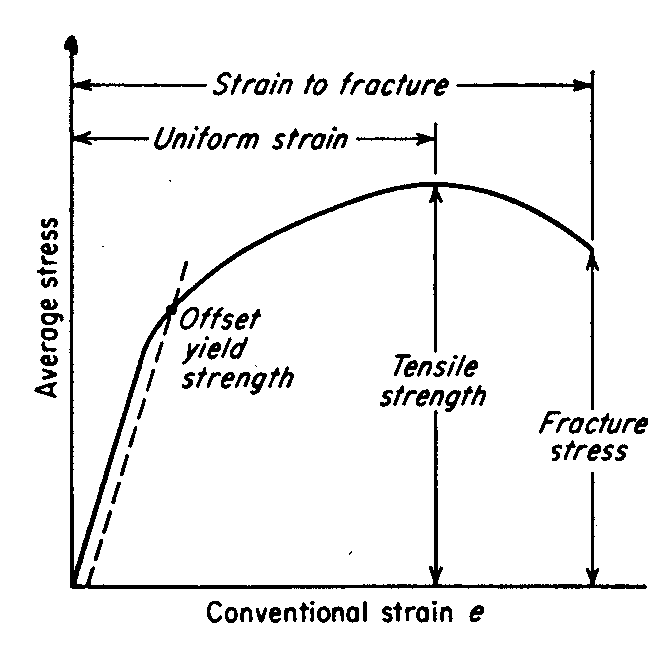
Figure 1. The engineering stress-strain curve
It is obtained by dividing the load by the original area of the
cross section of the specimen.
 |
(1) |
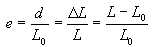
The strain used for the engineering stress-strain curve is the
average linear strain, which is obtained by dividing the elongation
of the gage length of the specimen, d, by its original length.
 |
(2) |
Since both the stress and the strain are obtained by dividing the
load and elongation by constant factors, the load-elongation curve
will have the same shape as the engineering stress-strain curve.
The two curves are frequently used interchangeably.
The shape and magnitude of the stress-strain curve of a metal will
depend on its composition, heat treatment, prior history of plastic
deformation, and the strain rate, temperature, and state of stress
imposed during the testing. The parameters, which are used to describe
the stress-strain curve of a metal, are the tensile strength, yield
strength or yield point, percent elongation, and reduction of area.
The first two are strength parameters; the last two indicate ductility.
The general shape of the engineering stress-strain curve (Fig. 1)
requires further explanation. In the elastic region stress is linearly
proportional to strain. When the load exceeds a value corresponding to
the yield strength, the specimen undergoes gross plastic deformation.
It is permanently deformed if the load is released to zero. The stress
to produce continued plastic deformation increases with increasing
plastic strain, i.e., the metal strain-hardens. The volume of the
specimen remains constant during plastic deformation, A·L = A0·L0 and
as the specimen elongates, it decreases uniformly along the gage length in cross-sectional area.
Initially the strain hardening more than compensates for this decrease
in area and the engineering stress (proportional to load P) continues to
rise with increasing strain. Eventually a point is reached where the
decrease in specimen cross-sectional area is greater than the increase in
deformation load arising from strain hardening. This condition will be
reached first at some point in the specimen that is slightly weaker than
the rest. All further plastic deformation is concentrated in this region,
and the specimen begins to neck or thin down locally.
Because the cross-sectional area now is decreasing far more rapidly than
strain hardening increases the deformation load, the actual load required
to deform the specimen falls off and the engineering stress likewise
continues to decrease until fracture occurs.
Tensile Strength
The tensile strength, or ultimate tensile strength (UTS), is the maximum
load divided by the original cross-sectional area of the specimen.
 |
(3) |
The tensile strength is the value most often quoted from the results of
a tension test; yet in reality it is a value of little fundamental
significance with regard to the strength of a metal. For ductile metals
the tensile strength should be regarded as a measure of the maximum load,
which a metal can withstand under the very restrictive conditions of
uniaxial loading. It will be shown that this value bears little relation
to the useful strength of the metal under the more complex conditions
of stress, which are usually encountered.
For many years it was customary to base the strength of members on the
tensile strength, suitably reduced by a factor of safety. The current
trend is to the more rational approach of basing the static design of
ductile metals on the yield strength.
However, because of the long practice of using the tensile strength
to determine the strength of materials, it has become a very familiar
property, and as such it is a very useful identification of a material
in the same sense that the chemical composition serves to identify a
metal or alloy.
Further, because the tensile strength is easy to determine and is a
quite reproducible property, it is useful for the purposes of
specifications and for quality control of a product. Extensive empirical
correlations between tensile strength and properties such as hardness and
fatigue strength are often quite useful. For brittle materials, the
tensile strength is a valid criterion for design.
Measures of Yielding
The stress at which plastic deformation or yielding is observed to begin
depends on the sensitivity of the strain measurements. With most materials
there is a gradual transition from elastic to plastic behavior, and the
point at which plastic deformation begins is hard to define with precision.
Various criteria for the initiation of yielding are used depending on the
sensitivity of the strain measurements and the intended use of the data.
-
True elastic limit based on micro strain
measurements at strains on order of 2 x 10⁻⁶ in | in. This elastic limit
is a very low value and is related to the motion of a few hundred
dislocations.
-
Proportional limit is the highest stress at which
stress is directly proportional to strain. It is obtained by observing the
deviation from the straight-line portion of the stress-strain curve.
-
Elastic limit is the greatest stress the material
can withstand without any measurable permanent strain remaining on the
complete release of load. With increasing sensitivity of strain measurement,
the value of the elastic limit is decreased until at the limit it equals
the true elastic limit determined from micro strain measurements.
With the sensitivity of strain usually employed in engineering studies
(10-4in | in), the elastic limit is greater than the proportional
limit. Determination of the elastic limit requires a tedious incremental
loading-unloading test procedure.
-
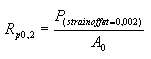
The yield strength is the stress required to
produce a small-specified amount of plastic deformation. The usual
definition of this property is the offset yield strength
determined by the stress corresponding to the intersection of the
stress-strain curve and a line parallel to the elastic part of the
curve offset by a specified strain (Fig. 1). In the United States the
offset is usually specified as a strain of 0.2 or 0.1 percent
(e = 0.002 or 0.001).
 |
(4) |
A good way of looking at offset yield strength is that after a specimen
has been loaded to its 0.2 percent offset yield strength and then unloaded
it will be 0.2 percent longer than before the test. The offset yield strength
is often referred to in Great Britain as the proof stress, where offset
values are either 0.1 or 0.5 percent. The yield strength obtained by an
offset method is commonly used for design and specification purposes
because it avoids the practical difficulties of measuring the elastic
limit or proportional limit.
Some materials have essentially no linear portion to their stress-strain
curve, for example, soft copper or gray cast iron. For these materials the
offset method cannot be used and the usual practice is to define the yield
strength as the stress to produce some total strain, for example,
e = 0.005.
Measures of Ductility
At our present degree of understanding, ductility is a qualitative,
subjective property of a material. In general, measurements of
ductility are of interest in three ways:
-
To indicate the extent to which a metal can be deformed without fracture
in metalworking operations such as rolling and extrusion.
-
To indicate to the designer, in a general way, the ability of the metal
to flow plastically before fracture. A high ductility indicates that the
material is "forgiving" and likely to deform locally without fracture
should the designer err in the stress calculation or the prediction of
severe loads.
-
To serve as an indicator of changes in impurity level
or processing conditions. Ductility measurements may be specified to assess
material quality even though no direct relationship exists between the
ductility measurement and performance in service.
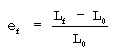
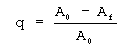
The conventional measures of ductility that are obtained from the tension
test are the engineering strain at fracture ef (usually called the
elongation) and the reduction of area at fracture q. Both of these
properties are obtained after fracture by putting the specimen back
together and taking measurements of Lf and Af .
 |
(5) |
 |
(6) |
Because an appreciable fraction of the plastic deformation will be
concentrated in the necked region of the tension specimen, the
value of ef will depend on the gage length L0 over which the
measurement was taken. The smaller the gage length the greater will
be the contribution to the overall elongation from the necked region and
the higher will be the value of ef. Therefore, when reporting values of
percentage elongation, the gage length L0 always should be given.
The reduction of area does not suffer from this difficulty. Reduction of area
values can be converted into an equivalent zero-gage-length elongation
e0.
From the constancy of volume relationship for plastic deformation
A*L = A0*L0, we obtain
 |
(7) |
This represents the elongation based on a very short gage length near the
fracture.
Another way to avoid the complication from necking is to base the percentage
elongation on the uniform strain out to the point at which necking begins.
The uniform elongation eu correlates well
with stretch-forming operations. Since the engineering stress-strain curve often
is quite flat in the vicinity of necking, it may be difficult to establish the
strain at maximum load without ambiguity. In this case the method suggested by
Nelson and Winlock is useful.
List of Articles - Knowledge Base